
Start with the kind of afternoon you want, then choose a part of Shanghai that can hold it. A broad river view, a tree-lined street and a compact old-city outing offer different experiences. Trying to sample all three in a few hours can turn the day into a sequence of transfers.
This is a guide to choosing, not a ranking of the city's best neighbourhoods. Use it to find one manageable area for your first free half-day. Save exact opening and booking questions for the places you decide to enter.
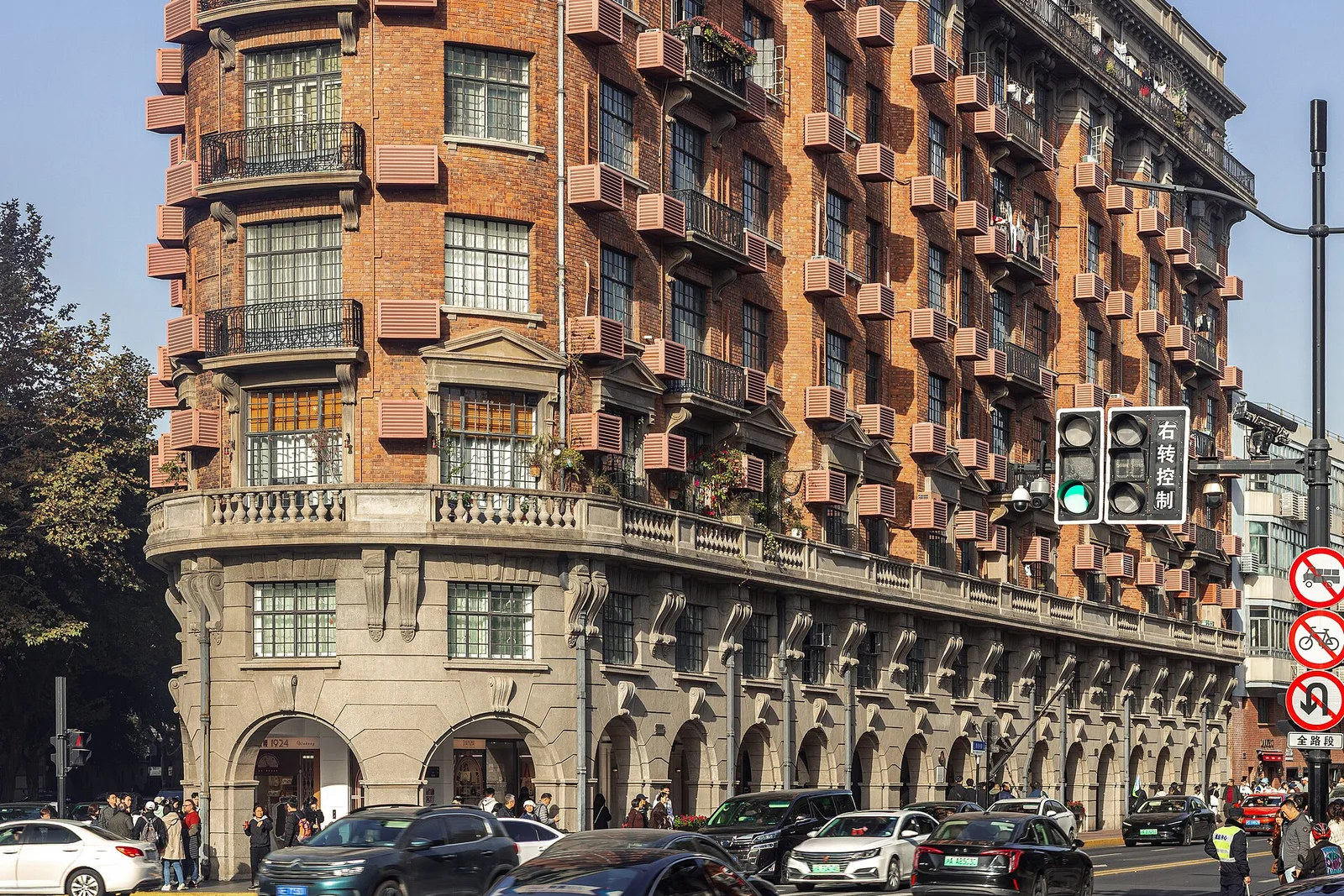
Supanut Arunoprayote · CC BY 4.0 · 2025-11-28 13:29:03. Cropped and resized; image derivative retains its source license. Source photograph (https://commons.wikimedia.org/wiki/File:Wukang_Mansion_20251128.jpg). License (https://creativecommons.org/licenses/by/4.0).
For a big introduction: the Bund and the river
Choose the Bund when your priority is understanding Shanghai at its largest visual scale. You can make the public waterfront the main event rather than treating it as a short photograph stop between unrelated attractions. Decide whether you want to spend the whole outing on one bank or give crossing the river a separate place in the day.
The city's heritage introduction describes the Bund through its historic waterfront buildings. Look back towards the façades as well as across the water. The contrast is more interesting when you give both views a little attention. The Bund: official heritage introduction (https://english.shanghai.gov.cn/en-HeritageZones/20231208/f2ac293f546a4d32aba936f2e733a47c.html)
For a first visit, keep the plan simple: an arrival point, a stretch of waterfront and a deliberate place to finish. If a viewpoint, cruise or tower becomes part of the outing, research that visit separately. A photograph of the skyline does not tell you which observation deck is open or how a particular ticket works.
For a smaller scale: Wukang Road and nearby streets
Choose this part of the city for street-level detail: building forms, trees, shopfronts and the changing rhythm of a smaller road. Shanghai's official Wukang Road guide identifies an area of varied residential and lane-house architecture in Xuhui. It is a useful starting point for looking carefully at an ordinary street. Wukang Road guide (https://english.shanghai.gov.cn/en-ScenicSpots/20231218/596192f5f59048bbbc3fa54d92304e93.html)
Begin with a small area around Wukang Mansion and Wukang Road rather than promising yourself an entire district. You can decide later whether to extend towards another street or stop for a longer break. A short outing that leaves room to notice details can be more rewarding than a long list of famous corners.
Keep pavements and crossings clear when taking photographs. Residential doors, courtyards and stairways are not invitations to enter. If a particular building has a visitor programme, use its published arrangements; otherwise enjoy the exterior from a public place.
For a pause within the city: Fuxing Park
Choose a park-centred outing if you want somewhere to sit between streets rather than another large indoor visit. Fuxing Park provides a useful change of pace, and its official introduction lists the address as 105 Yandang Road. Check the park's current arrangements when planning your route. Fuxing Park (https://english.shanghai.gov.cn/en-Parks/20250220/636b3df5761e4055b731a92d2abddcb3.html)
Do not treat a park stop as empty time to be squeezed out of the itinerary. It can be the reason a day remains comfortable. Bring a drink, leave space to sit and choose only one nearby continuation. If you are tired, ending after the park is a complete plan.
If step-free access or a particular entrance is important, verify that entrance separately. A green shape on a map and a photograph of a path do not establish the accessibility of the full journey from your accommodation.
For concentrated sights and food: the old city
Choose an old-city outing when you want a mixture of public streets, a possible garden visit and a meal within one general area. Keep the garden, surrounding commercial streets and any separate ticketed experience distinct in your notes. A place name used broadly in travel writing can conceal several different visitor arrangements.
Make a decision about the main visit first. If entering a garden matters to you, check its current ticketing and visit conditions before adding everything around it. If you mainly want to wander and eat, you may prefer a simpler public-street plan without a fixed appointment.
For food, start with a category you want to understand rather than a queue you have seen online. It might be soup dumplings, a bowl of noodles or a place to sit with tea. Check ingredients and portion sizes at the actual business, and leave another nearby option in case the first choice does not work for your group.
Make the choice fit your day
Think about what is happening before and after the outing. A neighbourhood that is convenient from your hotel may be a better first choice than one that requires a long cross-city transfer. On a departure day, give more weight to the return journey than to adding one last famous street.
Choose one anchor and one optional extension. The anchor is the experience you came for; the extension is something you can drop without feeling that the day has failed. Keep a meal or a rest as a real part of the plan, especially if the morning has already involved a large sight.
The commercial trip planners reviewed for this edition also organise Shanghai by areas. We use that as a useful planning comparison, while building our own reading and route structure. A private-tour itinerary should not be assumed to work unchanged when you are walking and using public transport. Shanghai trip-planning comparison (https://www.chinahighlights.com/shanghai/shanghai-trip-planner.htm)
Four questions before you set off
- What is the main reason for choosing this area today?
- Where will you arrive, and where could you comfortably finish?
- Which part depends on a booking or current opening arrangement?
- What will you drop if you want a shorter outing?
Save the Chinese names of the places you choose. For a more complete suggested sequence, use the Shanghai route chapters rather than joining several unrelated lists of recommendations. Information checked on 31 October 2026; this introductory guide does not claim a newly field-tested route.
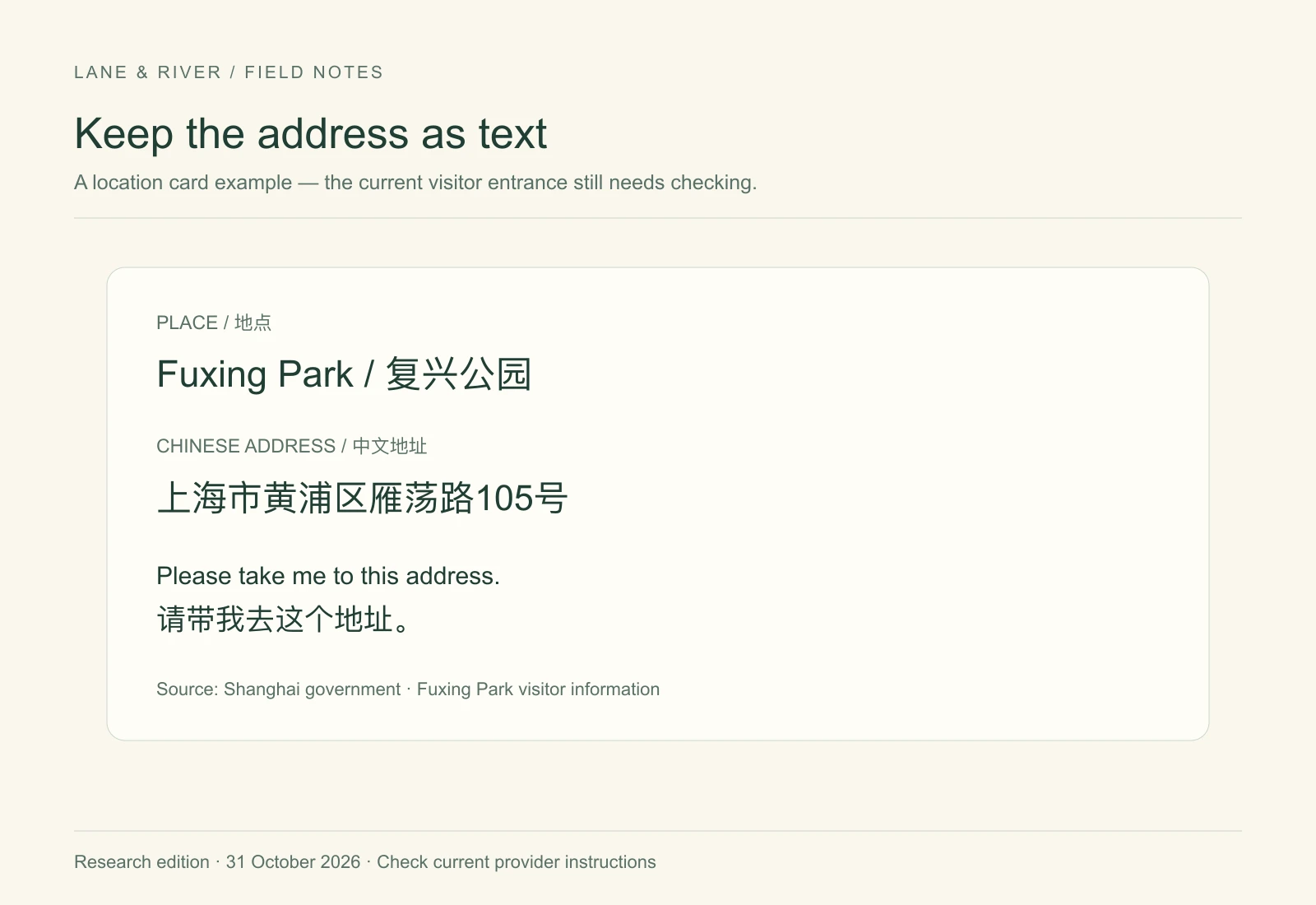
Original editorial diagram · Lane & River. Text is also provided in the article.
Fuxing Park · 复兴公园. Chinese address: 上海市黄浦区雁荡路105号. “请带我去这个地址。” — Please take me to this address. Confirm the current entrance separately.
Wukang Mansion
武康大楼
Street-view landmark; residential interiors are not part of this route.
Fuxing Park
复兴公园
Separate park continuation; listed address is 105 Yandang Road.
Shanghai sample places
A small public selection from the Shanghai research edition.
Open this collection on the map
5 places · returns you to this paragraph