
The most useful preparation for a first train journey is knowing four things: the exact departure station, the departure time, the identity document attached to the booking, and the carriage and seat. Once those are clear, you can work through the station one step at a time.
This guide follows a first journey booked with a foreign passport. It does not set a universal arrival buffer, because a small station and a large transport hub can require very different amounts of walking and queuing. Give your first journey more space than a connection you already know.

Ermell · CC BY-SA 4.0 · 2015-05-19 11:05:55. Cropped and resized; image derivative retains its source license. Source photograph (https://commons.wikimedia.org/wiki/File:Shanghai_railway_station_high_speed_train-20150519-RM-110555.jpg). License (https://creativecommons.org/licenses/by-sa/4.0).
Choose the station before you choose the departure
A city name alone is not enough to plan the trip to the station. Copy the full station name from the booking and save its Chinese version alongside the English. For Shanghai, 上海虹桥站 means Shanghai Hongqiao Railway Station; 上海站 means Shanghai Railway Station. Do not shorten either to “Shanghai station” when arranging a ride.
Compare the whole journey when choosing a service. A departure that looks slightly later may be easier if its station is closer to where you are staying. Think about the time to reach the station, find the right entrance and get through the departure process, as well as the time spent on the train.
Make a small travel card containing the station name, date, train number and departure time. Keep the booking itself available on your phone. If you are taking a taxi, show the station name and ask the driver to confirm it before setting off, rather than showing a screenshot with several stations on it.
Book using the traveller's actual document details
China Railway's English FAQ describes real-name ticketing and accepts valid foreign passports on its English website. It also says to keep the booking information and the document used to buy the ticket for station entry, exit and boarding. China Railway 12306 English FAQ (https://www.12306.cn/en/faq.html)
Use the same document details consistently throughout the booking. Review names, passport number and journey date before paying, especially if one person is entering details for several travellers. A booking confirmation is a good moment to check mistakes; the station entrance is a much less comfortable place to discover one.
If you use a booking agent, keep its support route as well as the railway booking details. Understand which service will handle a change or refund before accepting the booking. An attractive departure time is less useful if you do not know how to retrieve the issued ticket information.
Prepare one screen and one small backup
Before leaving your accommodation, find the confirmed journey in the app or email. Save the practical information for offline reference: full station name, departure time, train number, carriage and seat. Avoid putting your passport number or other private details on a publicly visible travel card.
Check how you will get to the station and what you would do if the first transport option failed. Charge the phone, keep the passport accessible and pack so you can move through the entrance without unpacking everything. Put the things you will use on the train into a small bag you can reach easily.
A photo of your passport is useful for some administrative situations, but do not treat it as a universal replacement for the original travel document. Keep the original document used for the booking with you and follow the railway's instructions for that journey.
At the station, work from the train number
First confirm that you have reached the correct departure station and the entrance being used for your service. Follow the station's directions for document checks and security. If a gate will not read your passport, ask a member of staff where to go instead of repeatedly trying adjacent gates without understanding the problem.
Once inside, use the train number to find the current departure information. Match the number as well as the destination: several trains can serve the same city. Check the board again after you have settled in, because the information you need is the station's current assignment, not a gate number saved from an earlier screenshot.
Stay near enough to the boarding area to respond when your service is called. Leave food shopping or exploring the station until you know where you need to be. If travelling with others, agree a simple meeting point and keep the journey details on more than one phone.
Find the carriage, then the seat
After entering the platform area, compare the carriage number on the booking with the train and station markings. Do not stop in a doorway to reorganise bags while others are boarding. If you are unsure, ask before the train departs and show the journey information without displaying more personal data than necessary.
Find the seat or berth shown on the booking, then put luggage where it is permitted and will not block movement. Keep the passport, phone and valuables accessible. A little organisation here makes the arrival easier: the items you will need to leave the train should not be buried beneath everything else.
If someone is in your seat, start by comparing the train, carriage and seat information calmly. A seat number without its carriage can be misleading. Ask staff for help when the information still does not match rather than assuming that the other person is on the wrong train.
Plan the arrival before the train stops
Check the exact arrival station and the final local transfer. A fast intercity journey can still end far from your accommodation. Save the hotel's Chinese address before travelling so that a tired arrival does not become another search task.
Keep your booking and document available until you have completed the station exit process. Once outside, use the designated onward-transport areas and confirm the destination of the next ride. If friends are meeting you, agree the arrival station and meeting location explicitly.
If plans change
Open the current booking and check the railway or booking service's available change or refund options. Fees and deadlines can depend on when the request is made and the kind of change. Avoid using a single percentage or time limit remembered from an old article as the rule for every situation.
If a departure is approaching and the online process is unclear, seek help promptly through the official station or booking channel. Keep the booking reference and original document ready. Buying another ticket before understanding the first booking may add a second problem instead of fixing the first.
Information checked on 31 October 2026. This is a preparation guide based on published railway information, not a report of a test booking. Current station instructions and the terms attached to your ticket take precedence.
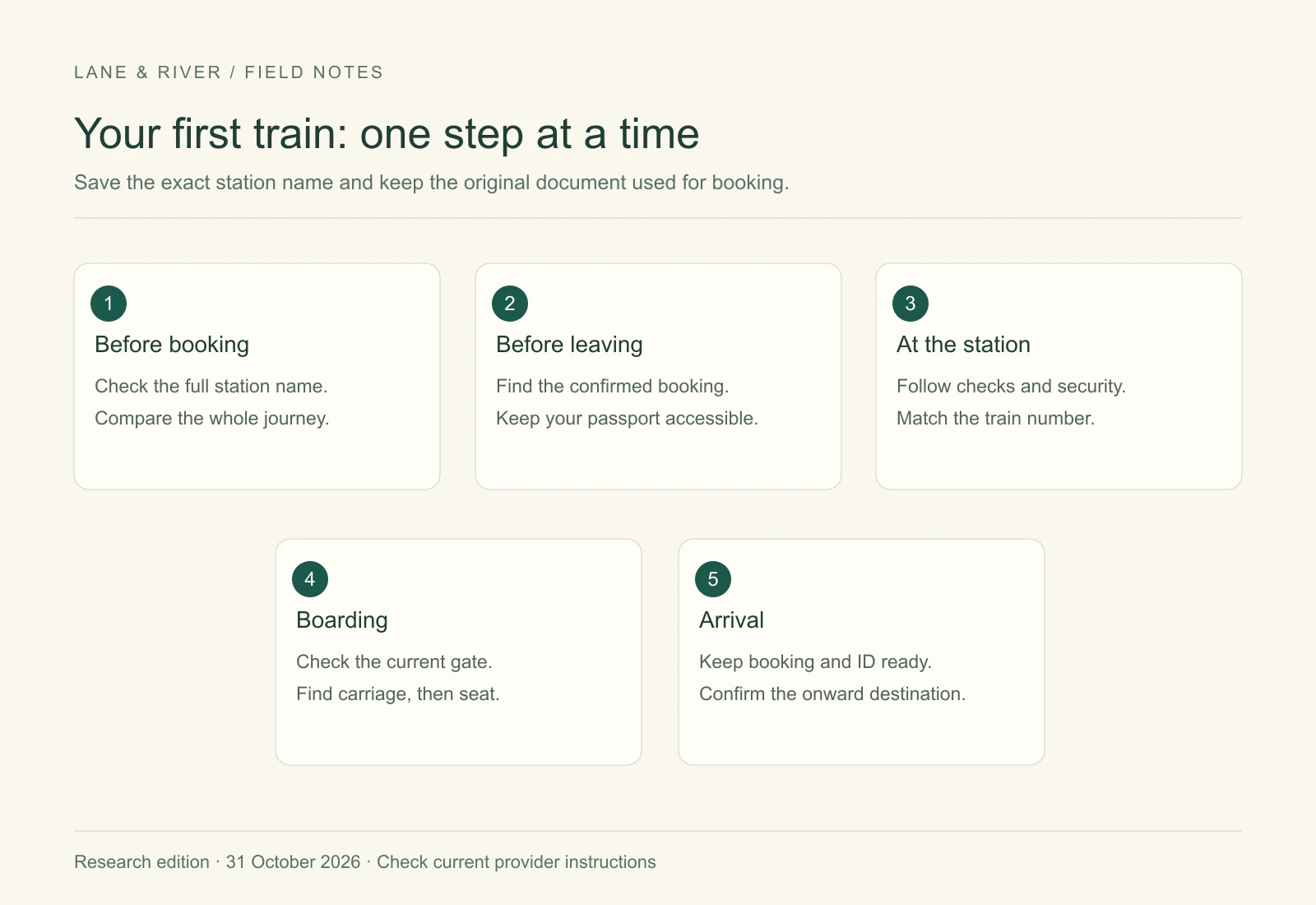
Original editorial diagram · Lane & River. Text is also provided in the article.