
Your first hour does not need a sightseeing plan. It needs a working destination, a way to stay connected, and a calm choice about transport. Finish those jobs before trying to optimise the rest of the day.
Use this guide after checking the entry and transit requirements for your own journey. The title describes the first set of tasks, rather than promising that immigration, luggage and a transfer can all be completed within sixty minutes.

Soramimi · CC BY-SA 4.0 · 2015-08-21 23:38:12. Cropped and resized; image derivative retains its source license. Source photograph (https://commons.wikimedia.org/wiki/File:Inside_view_of_Shanghai_Pudong_International_Airport.JPG). License (https://creativecommons.org/licenses/by-sa/4.0).
Before landing, make an arrival note
Save your accommodation's name, Chinese address, contact details and booking reference where you can open them without a connection. Add the correct airport and terminal from your flight information. PVG refers to Shanghai Pudong International Airport; SHA refers to Shanghai Hongqiao International Airport. Check the actual booking rather than relying on a city name.
If you expect a driver or a host, save the agreed meeting instructions. A screenshot with the meeting point is useful, but it should be supported by a contact method and a plan for a delayed arrival. Tell a travelling companion where the same information is stored.
Put your phone charger, passport and the arrival note somewhere easy to reach. Try opening the saved address in flight mode before you leave home. This small test tells you more than assuming that a page will remain available after you close an app.
Finish the airport process first
Follow the airport and border staff's instructions for your arrival. Keep the passport and flight details available until you have finished the required checks and collected your luggage. If you have an onward connection or an unusual itinerary, ask the appropriate airline or airport desk before leaving the area you may need.
Once you have your bags, take a moment to check that you still have the phone, passport and essentials. Move out of the flow of passengers before opening several apps. There is little benefit in solving payment setup while blocking a busy exit with your luggage.
If the journey has left you tired, choose fewer decisions. A confirmed destination and one workable transfer matter more than finding the theoretically cheapest or fastest combination for every possible arrival time.
Get enough connectivity for the next step
Shanghai's airport service information describes one-stop international visitor centres in Pudong T1 and T2 and Hongqiao T1, offering help with payment, communication, tourism and transport. Look for current airport signs and ask staff for the appropriate desk. Airport visitor services (https://english.shanghai.gov.cn/en-LatestNews/20260319/526f61df226649a58acf4b174d18f8aa.html)
If your roaming or travel-data plan already works, use it to confirm your destination and onward route. You can compare longer-term mobile options later. If it does not work, use an official help point to understand the available connection or SIM options rather than buying the first offer simply because you need a signal.
Keep the Chinese address available even when you get online. It remains useful if the phone loses its connection during the transfer. Avoid making every part of the journey depend on the same temporary Wi-Fi session.
Choose transport around your actual destination
For Pudong, the city's airport guide lists metro, maglev, buses and taxis. The maglev connects with Longyang Road, where another transfer may still be needed. Hongqiao's terminals have different metro connections, so first confirm which terminal you are using. Shanghai airport transport guide (https://english.shanghai.gov.cn/en-Transportation/20231214/649e06ea38f74aaeb573fa2debbe97d3.html)
Compare the full route to the accommodation: station changes, walking with bags, the final section from a station and the services still running when you arrive. A fast first leg does not necessarily make the whole journey simpler. When travelling with several bags or someone who is tired, reducing transfers may be worth more than a small saving.
For a taxi, follow the airport's official taxi signs and confirm the destination using the Chinese address. For a pre-booked car, use the meeting instructions provided by that service. Keep the method for identifying the vehicle and driver separate from vague offers of a ride in the terminal.
Make a separate plan for late arrivals
Before committing to a rail or bus option, check the current service information for your arrival time. Do not assume a route described in a daytime travel article will still be running after a delayed flight. The airport guide itself notes that schedules can change.
If the intended option is no longer available, decide on an alternative before leaving the terminal's information and service area. Confirm how you will pay and how to contact the accommodation. An earlier message saying “I may arrive late” is useful, but the property also needs to know about a significant delay when you have a connection.
If the onward journey now feels complicated, ask an official information point to help you establish the next practical step. You do not need to solve the whole Shanghai transport network while standing in the arrivals hall.
Keep payment setup proportionate
Use the method you have already prepared if it is accepted. If an app needs more work, keep a backup available for the transfer and come back to setup when you have a reliable connection and somewhere to sit. Read Paying in China, with a backup plan (/en/guides/paying-in-china/) before depending on a single phone-based method.
Know whether you are paying for a ticket, a top-up, a booked transfer or the final taxi fare. Ask the amount before confirming a payment that you enter manually. A successful transaction screen and confirmation from the provider are more useful than simply seeing money leave an account.
The point at which you can stop planning
You are ready to leave the airport when you know where you are going, how the chosen transfer gets you there, how to pay, and what to do if that transfer fails. Save any remaining research for a rested first morning.
- Destination and Chinese address saved offline.
- Airport and terminal confirmed.
- Current transport option checked for the actual arrival time.
- Payment method and backup available.
- Accommodation contact and late-arrival instructions accessible.
Information checked on 31 October 2026. Counter locations, operating times and transport arrangements should be checked against the current airport or operator information before travelling. The accompanying terminal photograph is an older location image, not a current wayfinding diagram.
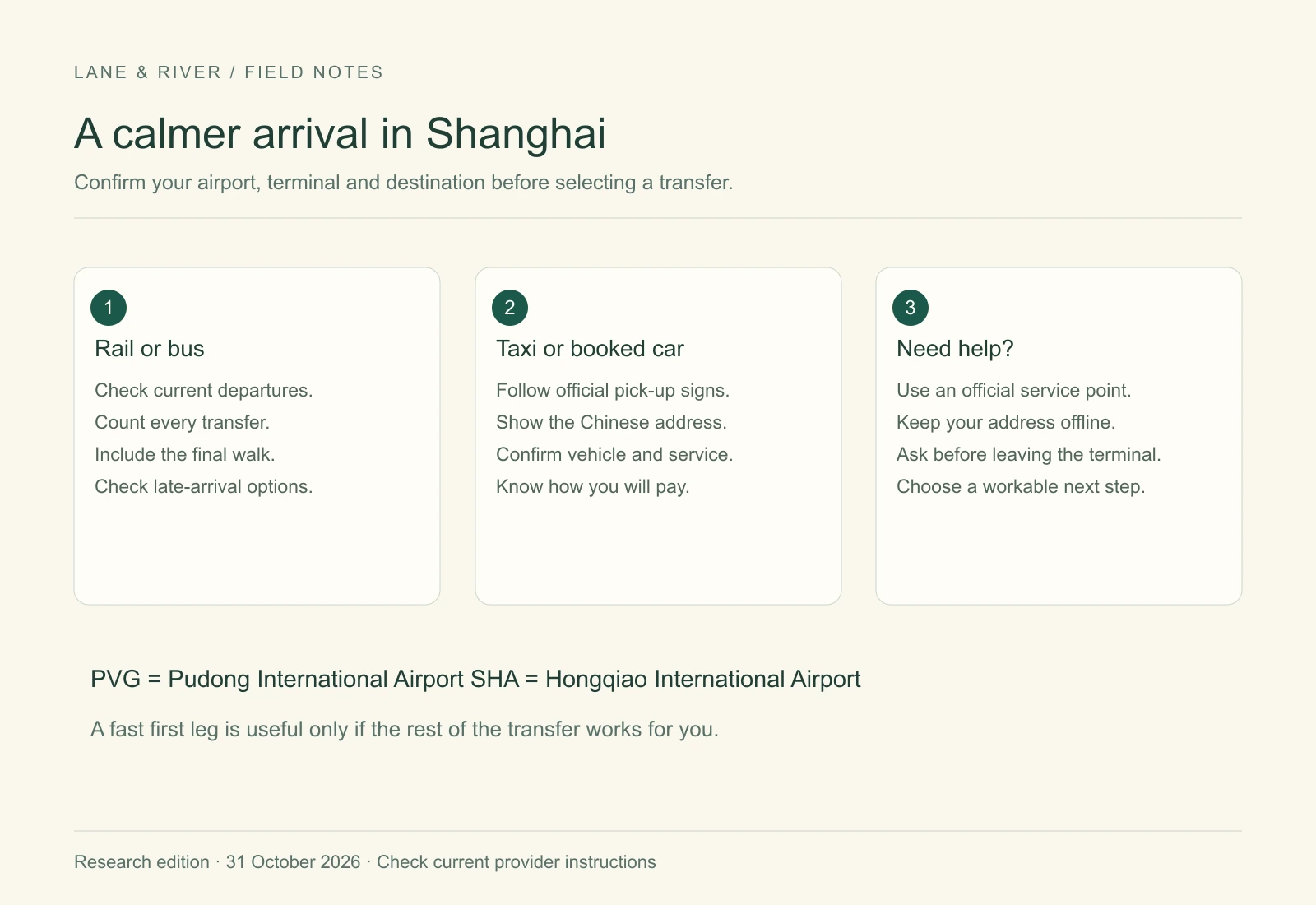
Original editorial diagram · Lane & River. Text is also provided in the article.